
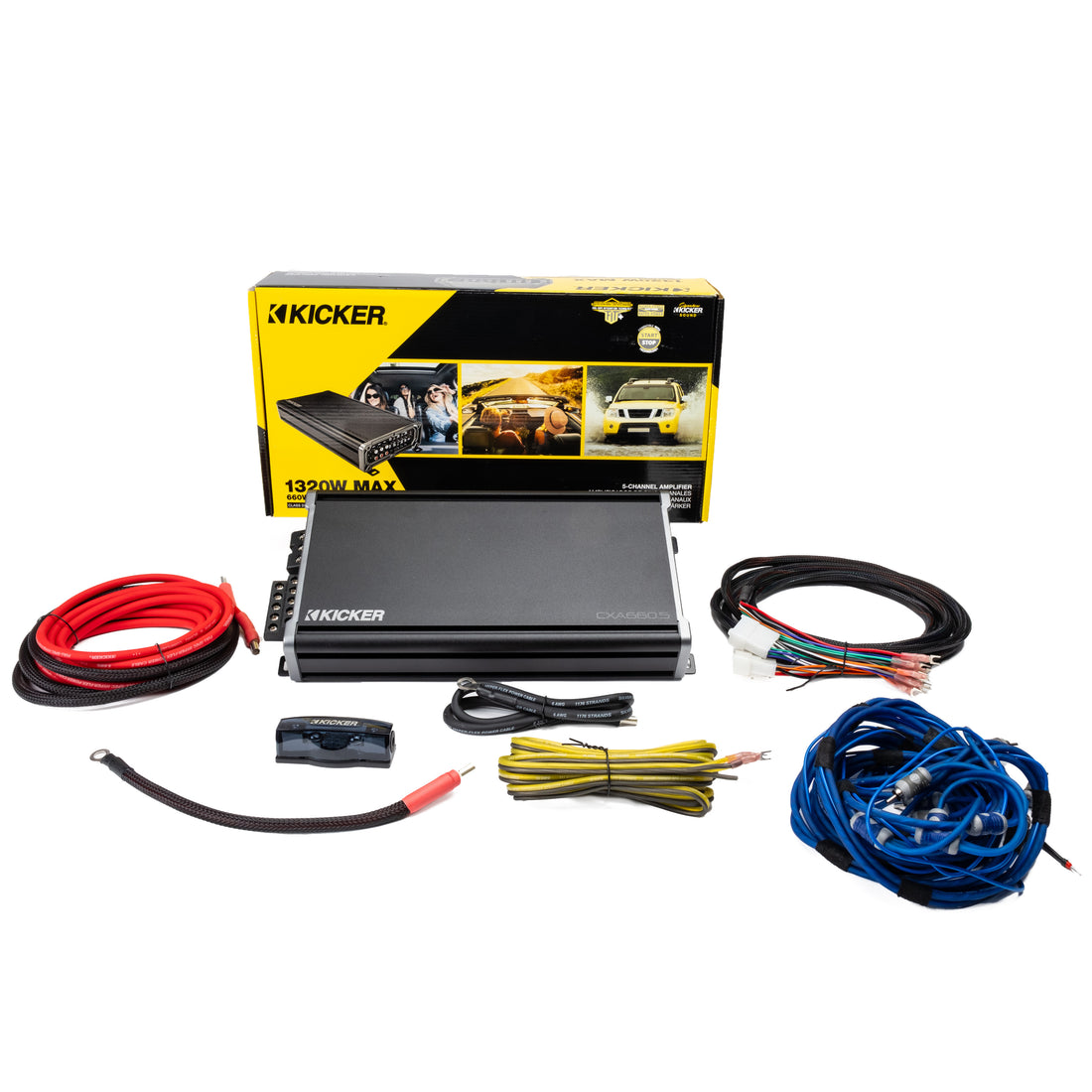
Welcome to the installation guide for your JBL Amplifier Bypass Plug & Play Bundle with Kicker 5 Channel Amplifier for the 2016–2023 Toyota Tacoma from Trail Grid Pro! This guide walks through accessing the factory JBL amplifier, routing the bypass harness, and connecting the Kicker 660.5 to your aftermarket radio. Read the full guide before starting.
Table of Contents
- Important Notes Before You Begin
- Installation Video
- Parts Included
- Tools Needed
- Step 1: Access the Factory JBL Amplifier
- Step 2: Access the Area Under the Front Passenger Seat
- Step 3: Remove the Passenger-Side Routing Trim
- Step 4: Connect the JBL Bypass Harness
- Step 5: Route the Bypass Harness Forward
- Step 6: Connect the Radio’s RCA and Remote Leads
- Step 7: Route the RCA and Remote Leads
- Step 8: Route the Power Cable
- Step 9: Connect the Ground Wire
- Step 10: Connect the Amplifier Inputs and Speaker Outputs
- Step 11: Inspect the Installation and Finish the Power Connection
- Step 12: Test the System
- Step 13: Set the Amplifier Controls
- Step 14: Reassemble and Complete the Final Checks
- Common Troubleshooting Solutions
- Contact Us
📢 Important Notes Before You Begin
Match your equipment: These instructions describe the Tacoma factory-JBL bypass installation with an aftermarket radio and the Kicker 660.5. If your supplied connectors, amplifier, or vehicle layout differ, contact us before modifying anything.
Factory subwoofer: The subwoofer-output instructions below apply when using the bypass harness to amplify the factory enclosure. Do not apply that wire pairing to a different subwoofer without confirming its wiring requirements.
Keep hardware organized: Photograph wiring and trim before removal. Keep seat, seat-belt, and trim fasteners separate so each returns to its original location.
⚠️ Important: Battery, seat, seat-belt, and power-wire safety
- Turn the vehicle off. Follow Toyota’s battery-disconnection procedure before working on wiring, the seat, or the seat-belt anchor.
- Follow seat-wiring precautions. Seat wiring may include airbag and occupant-sensor connections. Follow the vehicle service instructions and required waiting period before disconnecting it.
- Do not pull on seat wiring. Support the seat while accessing its connectors, and release each connector as directed in the vehicle service instructions.
- Keep amplifier power disconnected while wiring. Leave the power cable disconnected from the battery and keep the inline fuse removed until the installation is checked.
- Use the specified fuse. Follow the amplifier and wiring-kit instructions for fuse rating and fuse-holder placement.
- Reinstall safety-critical fasteners correctly. Use Toyota’s specified procedure and torque for seat bolts and the seat-belt anchor. Do not drive with them loose.
- Get help if you are unsure. Have a qualified installer handle seat wiring, seat-belt work, battery connections, or firewall routing if needed.
🎥 Installation Video
Parts Included
- One Kicker 660.5 5-channel amplifier
- One plug-and-play JBL bypass harness
- Three pre-bundled 3-meter, 2-channel RCA cables with a blue remote wire
- One RCA splitter with double female adapters
- Red power wire
- Kicker inline fuse block
- Black ground wire
- Four pieces of Velcro
- One male and one female bullet connector
- One supplied 10mm-head bolt
Check for shipping damage and missing parts before taking the vehicle apart. Contact us if anything is missing or damaged.
🛠️ Tools Needed
- 10mm socket and compatible ratchet
- 12mm wrench or socket for the battery-terminal hardware described in this kit
- 14mm wrench or socket for the seat and lower seat-belt fasteners described below
- 3mm Allen wrench for amplifier and fuse-holder connections
- Panel removal tool, preferably plastic
- Phillips-head and small flat-head screwdrivers
- Utility knife
- Wire fish or suitable protected wire-pulling tool
- Electrical tape
- Side cutters
- Zip ties
- Appropriate crimping tool for the supplied bullet connectors
- Torque wrench for reinstalling seat and seat-belt fasteners to Toyota’s specifications
📝 Step-by-Step Instructions
Step 1: Access the Factory JBL Amplifier
The factory JBL amplifier is behind the rear passenger-side seat, beneath the plastic trim. Complete the battery and safety preparations above before disconnecting wiring.
- Fold up the lower rear-seat cushions on both sides.
- Remove the rear headrests on both sides.
- Fold the rear seatbacks flat.
- Remove the two or three 10mm-head bolts holding the driver-side rear trim panel, depending on model year.
- Carefully release and remove that panel.
- Remove the 10mm-head bolt at the upper-left corner of the passenger-side rear trim panel.
- Release and remove the passenger-side panel.
- Locate the JBL amplifier attached to the factory Toyota subwoofer enclosure.
- Release and unplug the three connectors on the amplifier’s right side.
- Release and unplug the connector below the amplifier that connects the subwoofer wiring to the enclosure.
The factory amplifier can stay mounted. If you choose to remove it, support it while removing its five 10mm-head mounting bolts, then lift it out and save the hardware.
Step 2: Access the Area Under the Front Passenger Seat
- Remove the two front 14mm-head passenger-seat mounting bolts.
- Slide the seat forward to reach its rear mounting points.
- Gently lift and pull back the two rear plastic bolt covers.
- Remove the two rear 14mm-head bolts.
- Move the seat back and carefully tilt it to reach the wiring underneath. Do not stretch the wires.
- Following Toyota’s service procedure, release the seat connectors and lift the seat out with assistance as needed.
Keep the seat protected and the four mounting bolts together. Do not switch the vehicle on with seat connectors disconnected.
Step 3: Remove the Passenger-Side Routing Trim
The door sills are the trim pieces along the bottoms of the door openings. The B-pillar is the upright section between the front and rear doors.
- Turn the front passenger kick-panel retaining knob counterclockwise to remove it.
- Gently release the kick panel beside the passenger’s feet and set it aside.
- Use a panel tool to release the two front-sill attachment clips near the kick-panel area toward the inside of the vehicle.
- Lift and remove the front passenger door-sill trim.
- Gently lift the rear passenger door-sill trim until its clips release, then remove it.
- Remove the plastic cover over the lower seat-belt anchor bolt.
- Follow Toyota’s service procedure to remove the 14mm-head lower seat-belt anchor bolt. Keep the anchor hardware together.
- Pull back only the sections of rubber door-opening trim beside the B-pillar, at both the front and rear passenger doors. Do not remove the seals completely.
- Use a panel tool to gently release the B-pillar trim and set it aside.
Step 4: Connect the JBL Bypass Harness
- Locate the supplied bypass harness’s 10-pin and 12-pin connectors.
- Match them to the corresponding factory plugs disconnected from the JBL amplifier.
- Push each matching plug together until fully seated. Do not force a connector that does not align.
Step 5: Route the Bypass Harness Forward
- Route the harness from the factory amplifier area toward the front passenger-seat opening.
- Follow the factory wiring channel along the passenger-side door openings.
- Keep the harness clear of mounting bolts, seat-belt hardware, seat tracks, and existing vehicle wiring.
- Leave enough slack at the amplifier end to make the connections without pulling on the harness.
Step 6: Connect the Radio’s RCA and Remote Leads
Access the back of the aftermarket radio using the vehicle- and radio-specific removal instructions. Support the radio instead of letting it hang by its wiring. RCA cables carry the audio signal; the blue remote wire tells the amplifier when to switch on.
- Connect FL and FR to the radio’s front-left and front-right RCA outputs.
- Connect RL and RR to its rear-left and rear-right outputs.
- Connect SL and SR to its subwoofer outputs.
- If the radio has only one subwoofer RCA output, attach the supplied Y-splitter to that output, then connect both subwoofer RCA leads using the supplied adapters as needed.
- Using the supplied bullet connectors and a suitable crimping tool, connect the bundle’s blue remote wire to the radio’s amplifier-turn-on lead.
- Check that the remote connection is secure and insulated.
Step 7: Route the RCA and Remote Leads
- Route the RCA bundle and remote wire down the passenger side of the dash toward the footwell.
- Continue behind the upper edge of the carpet toward the bottom of the windshield-pillar area.
- Open the factory wiring-channel covers by releasing their tabs with a small flat-head screwdriver.
- Follow the channel to the area under the front passenger seat.
- Pass the cables under the carpet and through the existing opening near the floor vents. Keep the vents unobstructed.
Step 8: Route the Power Cable
Keep the battery end disconnected and the inline fuse removed throughout this step.
- Plan the fuse-block position using the amplifier and wiring-kit requirements.
- Connect the short shielded power-cable section to one side of the fuse block.
- Connect the long shielded section to the other side.
- Seat each protective grommet in its groove and secure the connections with the appropriate Allen wrench.
- Fit the Kicker fuse-block cover.
- Route the long cable along the inside of the driver-side fender toward the firewall, then across to the passenger-side firewall grommet, as described for this installation.
- Secure it away from hot components, sharp edges, and moving parts.
- Inspect both sides of the passenger-side firewall grommet and identify a clear rubber area away from factory wiring.
- If an opening is needed, carefully make a small X only in that clear rubber area. Some Toyota grommets have inner and outer membranes.
- Use a protected wire-pulling tool to guide the cable into the cabin without damaging existing wiring or the grommet.
- Route the cable behind the kick panel, along the factory wiring channel, and under the carpet to the amplifier location.
- Connect it to the amplifier’s labeled positive power terminal and secure it with the appropriate Allen wrench, following the amplifier manual.
⚠️ Important: Never cut blindly into a firewall grommet.
If you cannot see and protect the existing wiring on both sides, stop and use a qualified installer. Keep the cable protected from metal edges and maintain the grommet’s protective seal. Do not connect the power cable to the battery yet.
Step 9: Connect the Ground Wire
- Connect the supplied black ground wire to the amplifier’s labeled ground terminal.
- Secure it with the appropriate Allen wrench.
- Route the wire under the carpet to the intended factory ground location under the seat.
- Attach it using the supplied 10mm-head bolt.
- Check that the connection is secure and the wire cannot catch in the seat tracks.
If you cannot identify the intended ground location, contact us rather than choosing an arbitrary seat or trim bolt.
Step 10: Connect the Amplifier Inputs and Speaker Outputs
- Position the Kicker 660.5 under the passenger seat.
- Check clearance for the seat, wiring, and floor vents, and allow the ventilation space required by the amplifier manual.
- Plan to secure it using the supplied Velcro or suitable mounting brackets, but finish the wiring before permanent mounting.
- Connect the RCA cables by their channel labels using the list below.
- Connect the blue remote wire to the amplifier terminal labeled REM.
RCA input connections:
- Amp 1 L: FL, gray
- Amp 1 R: FR, blue
- Amp 2 L: RL, gray
- Amp 2 R: RR, blue
- Sub L: SL, gray
- Sub R: SR, blue
Match the printed left/right and channel labels rather than relying on color alone.

Speaker-output connections from the JBL bypass harness:
Match each wire to the amplifier’s printed output label. Place the fork terminal, the U-shaped metal connector, beneath its clamping plate and tighten the terminal screw securely. Check that no exposed strands or connectors touch adjacent terminals.
Rear speakers, Amp 2, bottom row in this installation:
- Left positive (+): green
- Left negative (−): green with black stripe
- Right positive (+): purple
- Right negative (−): purple with black stripe
Front speakers, Amp 1, top row in this installation:
- Left positive (+): white
- Left negative (−): white with black stripe
- Right positive (+): gray
- Right negative (−): gray with black stripe

Subwoofer outputs, only when amplifying the factory enclosure with this bypass harness:
- Sub negative (−), bottom row: black and orange with black stripe
- Sub positive (+), top row: red and orange
Confirm the labeled terminals and supplied harness before making these paired connections. Stop and contact us if your harness differs.
Step 11: Inspect the Installation and Finish the Power Connection
- Check every power, ground, remote, RCA, and speaker connection.
- Check that cables cannot be pinched by trim, seat tracks, mounting bolts, or seat-belt hardware.
- Confirm the fuse rating and fuse-holder placement against the amplifier and wiring-kit instructions.
- With the battery still isolated and the inline fuse removed, attach the short power cable’s pre-fitted ring terminal to the positive (+) battery-terminal connection as directed by the vehicle and kit instructions.
- Secure the amplifier and restore the passenger-seat wiring and mounting before powering the vehicle. Follow Toyota’s service procedure and specified seat-bolt torque.
- Restore the seat-belt anchor using Toyota’s specified procedure and torque before using the seat.
- Complete battery reconnection and fuse installation in the order required by the vehicle and amplifier instructions, only after all wiring is finished and checked.
Step 12: Test the System
- Start with the radio volume low and amplifier gains at minimum.
- Switch on the radio and check that the amplifier powers on.
- Play a familiar track and check the front speakers, rear speakers, and subwoofer.
- Use the radio’s balance and fader controls to help check each speaker location.
- Stop if sound is missing, distorted, or cutting out. Troubleshoot before increasing the volume.
Step 13: Set the Amplifier Controls

For the RCA-input arrangement in this guide, use these starting switch positions:
- Fader: ON
- Input Level: LO
- Sub Input: SUB
- Follow the Kicker manual’s gain-setting procedure for your radio and amplifier. Gain matches the radio signal to the amplifier; it is not an extra volume control.
- Choose a familiar track that will play for several minutes.
- Use a clean, undistorted radio volume for adjustment. The original kit procedure uses about 75% of maximum volume, but not every radio stays clean at that level.
- Starting at minimum, adjust Amp 1 gain for the front speakers using a small flat-head screwdriver, within the amplifier manual’s limits.
- Repeat for Amp 2, then the subwoofer gain.
- Reduce the gain and radio volume immediately if sound becomes distorted or cuts out. Investigate the cause before continuing.
⚠️ Important: Do not tune through distortion.
Clipping, distortion, or sound that stops can indicate a setup or wiring fault. Lower the volume and gains and inspect the installation. Ask a qualified audio installer if you are unsure how to set gains correctly. Make final radio EQ adjustments only after establishing clean sound.
Step 14: Reassemble and Complete the Final Checks
- Turn the vehicle and audio system off before finishing trim work.
- Confirm that the amplifier is secured and that wiring cannot contact the seat tracks or obstruct the floor vents.
- Close the wiring-channel covers without trapping cables.
- Refit the B-pillar trim and confirm the lower seat-belt anchor was restored to Toyota’s specification. Do not leave the belt twisted or trapped behind trim.
- Press the loosened sections of rubber door-opening trim back into place.
- Refit the front and rear door-sill trim and the kick panel with its retaining knob.
- Confirm all four front passenger-seat bolts were tightened to Toyota’s specification, then replace their covers.
- Refit the radio and dash trim using the vehicle-specific instructions.
- Refit the rear trim panels and their original fasteners, then return the rear seats and headrests to their normal positions.
- Check seat movement and confirm that no cable catches or pulls tight.
- Test the audio again and check for warning lights or affected vehicle functions. If a seat or airbag warning appears, stop and have the system checked.
Congratulations on installing your JBL Amplifier Bypass Harness and Kicker 5 Channel Amplifier!
🛠️ Common Troubleshooting Solutions
The Radio Works, but There Is No Sound
Check whether the Kicker amplifier powers on. Before touching wiring, isolate power using the appropriate vehicle and amplifier procedures. Inspect the remote lead at both the radio and REM terminal, the power and ground connections, and the bypass-harness plugs. Confirm the RCA leads reach the matching inputs.
The Factory Subwoofer Does Not Play
Check the radio’s subwoofer-output setting and the Sub RCA connections. For this RCA arrangement, confirm Sub Input is set to SUB. With power isolated, check the factory-enclosure harness connections against the subwoofer-output pairing in Step 10. Do not substitute wiring from a different subwoofer setup.
Front and Rear Sound Do Not Match the Radio Controls
With power isolated, compare the FL, FR, RL, and RR cable labels at both ends. Check the front speaker outputs on Amp 1 and the rear outputs on Amp 2. Do not rely on RCA connector color alone.
Sound Is Distorted or Cuts Out
Lower the volume and gains. With power isolated, inspect for loose terminals, stray wire strands, damaged cables, and an insecure ground. Check ventilation and follow the amplifier manual for protection indicators. Do not fit a higher-rated fuse to hide a fault.
A Plug or Mounting Location Does Not Match
Stop before modifying anything. Send us your Tacoma’s model year, radio and amplifier models, and clear photos of the supplied harness and the connection in question.
Contact Us
Need help? Use our contact form and include your Tacoma’s model year, radio and amplifier models, a description of the issue, and clear photos of the relevant wiring.


